
Shock Waves. Photography Rocks Representations


Shock Waves. Photography Rocks Representations
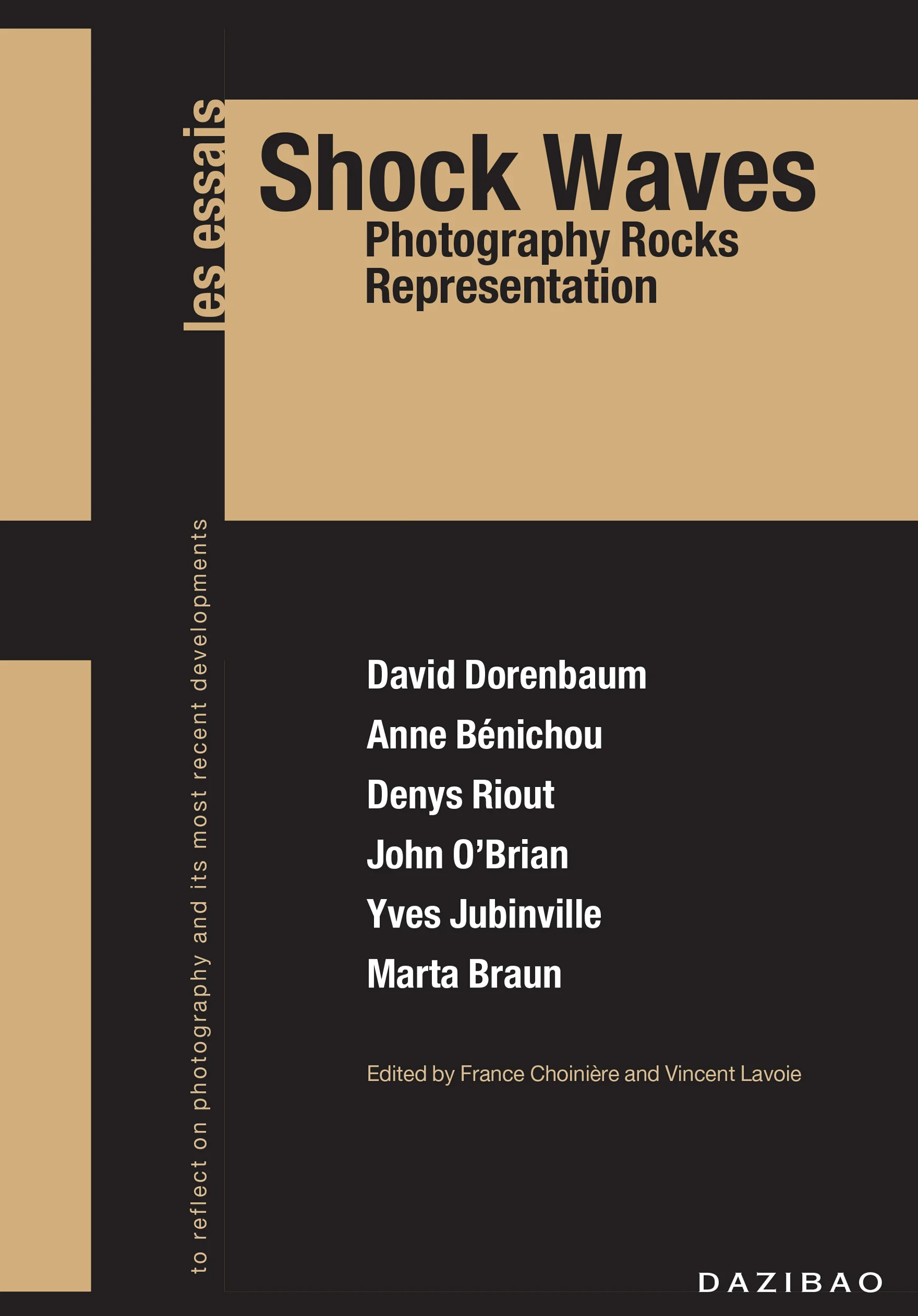
This new title in the les essais collection brings together six texts around the cultural, intellectual, and social importance of photography studies. In order to accomplish this, the authors included here are scholars whose field of study is not necessarily photography, but for whom dealing with various issues in photography is unavoidable. There is a disconcerting contribution by the psychoanalyst Dr. David Dorenbaum, for example, and a no less original article by Yves Jubinville, a theatre specialist. Scholars for whom photography and its interaction with other disciplines is their primary work, such as Anne Bénichou, Marta Braun, and Denys Riout, also contribute to this book. A preface by Vincent Lavoie, who co-edited the book with France Choinière, allows the reader to fully grasp the issues raised. In addition, a selection of work by Dave Heath has been slipped into the publication, like a supplementary editorial ― and visual – commentary.
LES ESSAIS
The collection entitled LES ESSAIS provides a site for discussion and confrontation between various currents of photographic theory. The texts in this collection explore the repercussions on photography resulting from the historical development of the gaze.
Authors: Anne Bénichou, Marta Braun, David Dorenbaum, Yves Jubinville, John O’Brian, Denys Riout
Artist: Dave Heath
Under the editorial direction of France Choinière and Vincent Lavoie
Design : Fleury/Savard, design graphique
2003
Texts in English and French, 228 pages, reproductions en noir et blanc, reliure allemande
ISBN: 978-2-922135-17-6
Other titles in this collection

Function/Fiction explores unsettling approaches to reality in which everything on view is first treated by a data recording system. Function/Fiction probes artistic practices that draw literally on the utilitarian images saturating our environment (images stemming from statistical systems, surveillance images, and ID and documentation images) to create fictional works. Whether it is a question of photography or of its various technological extensions, this publication proposes a re-evaluation of the history of the gaze by suggesting other precepts than those of optics or the mechanics of photography to think about our relationship to reality, to a world where almost everything is subject to a pre-mediatisation.

In the spring of 2004 Dazibao presented a three-part project entitled Performance et Photographie: POINT & SHOOT. The event brought together several artists for two exhibitions and one day of performances. This book is an extension of the project. Six writers have been invited to continue reflecting upon the connections between photography and performance, moving beyond what is apparently their most obvious relationship — the recorded image’s function to document transient practices.

This work deals with the fictional dimension of photography and the sometimes sly relationships that a medium such as this, so heavily inflected by the real, can have to the world of the imagination. It is not a question here of examining the narrative systems that photography can put to such good use, but of looking at how it manages, often in an adulterated state, to allow this shift toward the imaginary, to deploy this slightly off-centre figure so essential to fiction. The contributors adopt a variety of approaches to the dilemma of fiction/photography.

In addition to articles by each of the authors, this book contains reproductions of art works that bring fresh understanding to the discussion. In the middle of the book is a section of twenty pages of reproductions of works presented at Dazibao in the context of its 1998-1999 Deviant Practices programming. Five authors explore deviant practices in photography, those practices that work photography over, that knead and shake it up, and push it in new directions, by probing its most intimate mechanisms in unusual confrontations with other disciplines. Among the subjects tackled is the increasingly common infiltration of the photographic, or of photography itself, into artistic practices that are not defined, a priori, as being part of photography. The authors discuss the unofficial history of photography, in which it has maintained, from its inception right up until recent new technological advances, uneasy relations with other media. They examine how the idea of photography as an iconic medium has become outmoded, and explore photography’s particular ability to undermine reality and work on a subversive plane.

This publication accompanies the two parts of THE FACE exhibition, entitled In Search of the Emblematic and Towards a Capture of the Photographic. The works presented are reproduced in the middle of the book. Adopting as their point of departure the photographic momentum resulting from the first photograph of the Shroud of Turin, the authors explore a number of fundamental principles of photography in order to reexamine the notion of the photographic, and discuss the gaze, the Other, on which photography depends to reveal itself before, during and after the actual shot, as well as the double necessity for mediation and mediatization. Also dealt with are the phenomenology of funeral rituals, and photography’s particular propensity to push up against limits.

This book, with its ephemeral title, published in conjunction with the exhibition of the same name, examines the stakes linked to the appearance and disappearance of an image, to that extremely precarious moment of tension when the image becomes possible. The book begins with a text by the exhibition’s curator, which serves as an introduction to the essays that follow. Taking the exhibition’s premises as inspiration and following their own respective trails, Georges Didi-Huberman, Ellie Epp and Rober Racine add their voices to Nicole Gingras’ in an exploration of the notion of the tenuous image. The works presented in the exhibition are reproduced in a section in the middle of the book.

This book, accompanying the conference of the same name, raises a number of issues, such as the epistemological hybridity that characterizes the discourse on photography, the obsolescence of a discourse founded on photographic ontology, the history of the gaze “forced” by photography, the emergence of a number of practices such as autobiography, staging, narrativity, manipulation, borrowing images, etc., the iconoclastic process adopted by some photographers, and the singular and melancholic bankruptcy of the photographic image.