
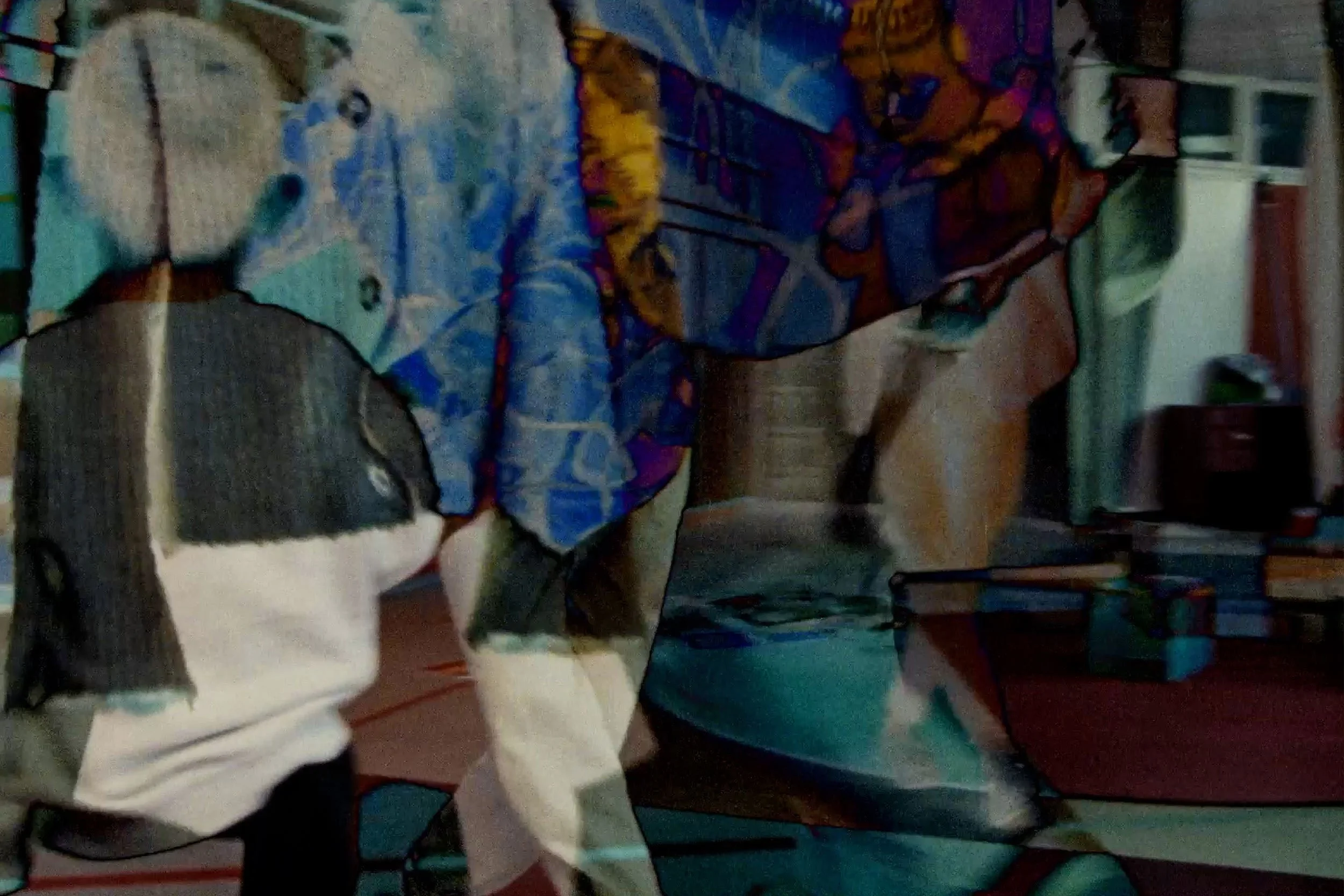
© Basma al-Sharif, Morning Circle (2025)

Carte blanche to Regards palestiniens: The Missing Image Is Gaza
On March 12, 2026 at 7 pm
— Facebook event
Seats are limited and admission is on a first-come, first-served basis. Please arrive a few minutes early.
The dv_vd series is an initiative of Videographe and Dazibao. This collaboration aims to create a dialogue between the centre's collection and the current video art scene. For this edition, carte blanche was offered to the Regards palestiniens collective, inviting them to develop an original program.
The Missing Image is Gaza brings together six short experimental films and video works that record life in Gaza and in exile through a series of ordinary and extraordinary gestures. Documenting decades of creative survival under the ongoing Nakba in Palestine, the artists and filmmakers practice cinema as a creative force of resistance in the face of the Zionist settler-colonial killing machine. Cooking, talking, journaling, live-streaming, photographing, animating, reenacting, and oral storytelling are among the many aesthetic and political strategies through which Palestinians have been confronting colonial violence since 1948. Bringing attention to moments shaped by enclosure, bombardment, dispossession, and displacement, the works featured in this program foreground ordinary acts as sites of political presence, insisting on life and visibility where they are most violently denied.
This program emerges from—and responds to—ongoing institutional silences and censorship within the cultural and academic fields here in Montreal, marked by a refusal to acknowledge, name, and take action against one of the most urgent and devastating realities of our present: the relentless live-streamed genocide in Gaza.
In addition to an annual screening series, which has been taking place in Montreal since 2007, the collective Regards palestiniens has, since October 7 2023, been actively developing and presenting film programs that center Gaza and foreground the decades-long Palestinian struggle for justice and liberation. These initiatives form part of a sustained effort to counter the systematic erasure of images from Gaza and Palestine more broadly. Across and beyond Montreal, we have curated and organized screenings that insist on Gaza’s presence within cultural and public spaces, including multiple iterations of Gaza: Between Bodies and Images, presented in Montreal and Toronto; the premiere of Gaza: From Ground Zero co-presented with Cinema Politica; Diaries of An Occupation, presented with Hors Champ at the Cinémathèque québécoise; and various programming initiatives held in solidarity with Palestinian liberation at student encampments, among many others. This work has also taken the form of more immediate, site-specific interventions, such as the first iteration of The Missing Image is Gaza, staged as an outdoor screening in the parking lot of Articule gallery, a co-organizer of the event.
Taken together, these actions reflect our ongoing commitment to challenge silence, propaganda, and marginalization by creating spaces for the circulation of diverse Palestinian voices and artistic practices—from Gaza and the diaspora alike. This screening is not an isolated event, but part of a sustained curatorial and political practice dedicated to insisting on Gaza’s visibility, complexity, and presence in the face of systematic attempts by the government, mainstream media, and cultural and academic institutions to suppress or contain it. This commitment is not only discursive but institutional: Regards palestiniens, Dazibao, and Vidéographe are among a growing number of cultural organizations across so-called Canada adhering to the guidelines of the Palestinian Campaign for the Academic and Cultural Boycott of Israel (PACBI), aligning curatorial practice with political responsibility and tangible action.
By placing Gaza at the center, we affirm that what has been rendered absent by dominant narratives is precisely what must be named and seen: that the missing image is Gaza. In so doing, our program disrupts institutional silence and reclaims cinema as a space of witnessing, collective responsibility, and solidarity.
— Regards palestiniens
Program — 71 min
Hadeel Asali, Daggit Gazza (2013) — 7 min 26 s
Taysir Batniji, Gaza Diary (2001) — 4 min 46 s
Amal Al-Nakhala, Limitless (2024) — 4 min 39 s
Areej Abu Eid, A Very Hot Summer (2016) — 16 min 43 s
Firas Shehadeh, Final Hour Log - Handala (2025) — 17 min 20 s
Basma al-Sharif, Morning Circle (2025) — 20 min 31 s
-
— 7 min 26 s
Daggit Gazza can be translated both as the spicy Gazan tomato salad customarily made in a mortar and pestle (called Daggah), as well as a term referencing the military pounding of Gaza. The film features the filmmaker preparing the salad along with audio of a phone call with her uncle in Gaza.
Hadeel Assali is a writer based in New York City. Her work focuses heavily on Gaza. She has also written on a secret Israeli transfer scheme to send 60,000 Palestinians from Gaza to Paraguay in 1969, which she hopes one day to turn into a film.
-
— 4 min 46 s
Combining domestic and street scenes in a cut montage, this series of still images is interspersed with short sequences and close-ups of a cleaver chopping meat. The discrepancy with the soundtrack drives home the point of the break—both formal and political—in Taysir Batnij’s diary in Gaza during the early months of the Second Intifada, the popular uprising against the Israeli army occupation from September 2000 to February 2005.
Born in Gaza in 1966, Taysir Batniji studied art at Al-Najah University in Nablus, Palestine. In 1994, he was awarded a fellowship to study at the School of Fine Arts of Bourges in France. Since then, he has divided his time between France and Palestine. During this period spent between two countries and two cultures, Batniji has developed a multimedia practice, including drawing, installation, photography, video and performance.
Taysir Batniji’s artwork, often tinged with impermanence and fragility, draws its inspiration from his subjective story, but also from current events and history. His methods of approach always distance, divert, stretch, conceptualize or simply play with the initial subject, offering, in the end, a poetic and sometimes acrid point of view on reality.
Already involved in the Palestinian art scene since the nineties, he expanded his participation since 2002 in a number of exhibitions, biennials and residencies in Europe and across the world, including Venice, Istanbul, Berlin and Lyon Biennials; Centre Pompidou and Jeu de Paume in Paris; the Rencontres d’Arles; Aperture in New-York; Martin-Gropius-Bau in Berlin; Vienna Kunsthalle; Witte de With in Rotterdam and V&A Museum in London.
Taysir was awarded the Abraaj Group Art Prize in 2012 and became the recipient of the Immersion residency program, supported by Hermes Foundation in alliance with Aperture Foundation in 2017. His works can be found in the collections of many prestigious institutions including the Centre Pompidou, the FNAC and the CNAP in France, the V&A, The Imperial War Museum and the Tate Modern in London, IVAM in Spain, the Queensland Art Gallery in Australia, Zayed National Museum in Abu Dhabi, Mathaf in Doha and Art Jameel in Dubai.
Batniji had four solo exhibitions in recent years, at The Rencontres d’Arles (2018), the Mac Val in Ivry-sur-Seine (2021), the Mathaf in Doha (2022), and the Palazzina dei Giardini in Modena (2025-2026).
Taysir Batniji’s work is represented by Sfeir-Semler Gallery (Hamburg/Beirut) and Eric Dupont Gallery (Paris).
-
— 4 min 39 s
Amal Al-Nakhala: “There is no description for the movie itself in order to let viewers create their own vision of the ending.”
Hello, I’m Amal, born in Gaza in 1999, and currently based in Cairo. I've been practicing art for many years, with my journey beginning from a deep desire to understand myself—what was truly going on in my mind and within me, then trying to explore the worlds within myself too, thus Art became a way to express that inner exploration. My style and ideas have always been deeply personal, focusing on raw emotions, ranging from self-doubt to guilt. While my work wasn’t initially political, the war in Gaza last October profoundly affected me. It led me to create an artistic diary that blends my writings with pieces I made during that intense period, capturing my experiences. Now, as I find myself in Cairo, my art has evolved with a new identity. It’s filled with symbolism and explores a variety of themes, with surrealism becoming a central element that feels like the perfect medium to express my vision.
-
— 16 min 43 s
The film is based on the personal experience of the filmmaker during the Gaza war of 2014.
“It’s Ramadan…a very hot summer…with no electricity and no fan…We thought it would be like the 1st and 2nd wars, but this one is different! It’s madness all day and all night long... We sleep a little here and there when the shelling stops…It is unbearably hot, as if hell opened its doors. Heat, fires and death...The sky is crimson red all night long as if with fireworks, like a scene from a horror movie but we are in it…”
“Making films makes me feel alive.” Areej lives in Nuseirat Refugee Camp in the Gaza Strip. She received a Bachelor degree from the Communication College at Al-Aqsa University in TV and Radio.
-
— 17 min 20 s
Final Hour Log – Handala reconstructs the last hour of the humanitarian vessel Handala, launched by the Freedom Flotilla Coalition (FFC) and named after the iconic figure created by Palestinian artist Naji al-Ali in the late 1960s. Handala, a barefoot refugee child with his back turned to the viewer, symbolizes Palestinian resistance, exile, and the right of return. Naji al-Ali was assassinated by Israel in 1987.
The vessel was intercepted by the Israeli navy in international waters on July 26, 2025. It was sailing to break Israel’s illegal blockade on Gaza—imposed since 2007 and escalated into a declared “complete siege” on October 9, 2023, through the deliberate cutting of essential supplies, amounting to an engineered campaign of famine and starvation. The crew faced surveillance, electronic jamming, intimidation, forcible boarding, and abduction.
Composed primarily of livestreamed footage, the film documents a civilian act of solidarity and defiance, preserving what was meant to be erased. An act of witness and rupture against the enforced silence, an act to break the siege on Gaza.
Firas Shehadeh is a Palestinian artist. His work explores worldbuilding, meaning, aesthetics, and identity. His practice investigates the post-colonial condition through the lens of technology, history, digitality, and speculative realities. Working across film, video, and sound, Shehadeh conducts a sustained inquiry into the ways narratives and identities are constructed, contested, and mediated within contemporary society. He holds a Master of Fine Arts from the Academy of Fine Arts Vienna.
Shehadeh’s work has been presented internationally at festivals and institutions including the second MUNCH Triennale, Almost Unreal (Oslo), the 18th Lo schermo dell'arte (Florence), the 14th Mercosul Biennial (Porto Alegre), London Short Film Festival, Centro de Cultura Digital (Mexico), Beta Festival (Dublin), Beursschouwburg (Brussels), Soft Centre (Naarm/Melbourne), Images Festival (Toronto), B7L9 (Tunis), Los Angeles Filmforum, Ashkal Alwan (Beirut), unsafe+sounds (Vienna), the 7th Singapore Biennale, Centre d’Art Santa Mònica (Barcelona), A.M. Qattan Foundation (Ramallah), 7th Cairo Video Festival, 4th Digital Marrakech and the 64th Berlinale (Berlin). Through his multifaceted practice, Shehadeh examines dominant paradigms and offers new perspectives on meaning-making and worldbuilding.
-
— 20 min 31 s
A short visceral narrative film unfolds in three parts to describe loss. From our earliest experience of separation to the imperceptible violence associated with integrating to a new country when yours is no longer livable, Morning Circle follows a father and son in their intimate rituals as they prepare to start the day and head to kindergarten.
Palestinian artist/filmmaker, Basma al-Sharif explores cyclical political histories and conflicts. In films and installations that move backward and forward in history, between place and non-place, she confronts the legacy of colonialism through satirical, immersive, and lyrical works.
Al-Sharif received an MFA from the University of Illinois at Chicago in 2007, was a resident of the Fondazione Antonio Ratti in 2009, the Pavillon Neuflize OBC at the Palais de Tokyo in 2014-15. She received a Jury prize at the Sharjah Biennial in 2009, was awarded a Visual Arts of the Fundación Botín in 2010, Mophradat’s Consortium Commissions in 2018, she was a fellow of the Berlin Artistic Research Grant Programme for 2022-2023 and was nominated for the Prix Aware for 2024. In 2025 al-Sharif published her first monograph titled "Semi-Nomadic-Debt-Ridden-Bedouins" and her film "Morgenkreis (Morning Circle)" won the Grand Prize at the 39th Internationale Kurzfilmtage Winterthur, the Best Documentary short at the Sharjah Film Platform 8, and ARTWORKS Best FilmAward, 14th Athens Avant-Garde Film Festival.
Major exhibitions include: Hannah Ryggen Triennial, The Gothenburg Biennial, Pompidou Metz, de Appel, the Museum of the Art Institute of Chicago, MOMA, CCA Glasgow, SALT Galata, the Whitney Biennial, Here and Elsewhere at the New Museum, Berlin Documentary Forum, and Manifesta 8. Her films have screened in the international film festivals of Locarno, Toronto, Berlin, Mar del Plata, Milan, London, New York, Montreal, and Yamagata amongst others. Basma is based in Berlin and represented by Galerie Imane Farés in Paris.
Regards palestiniens is a grassroots film collective dedicated to Palestinian cinema and based in Tiohtià:ke / Montreal.
Since 2005, we have focused on activating the political potential of aesthetics in Palestinian cinema. We aim to organize and curate screenings as gatherings for cinematic discussion and for raising political consciousness.
We’ve also engaged in direct action, confronting institutional censorship and artwashing in cultural and academic spaces. We continue to educate and organize around the Palestinian Campaign for the Academic & Cultural Boycott of Israel (PACBI).

Dazibao thanks the artists, Regards palestiniens and Vidéographe for their generous collaboration as well as its advisory committee for their support.
Dazibao receives financial support from the Conseil des arts et des lettres du Québec, the Canada Council for the Arts, the Conseil des arts de Montréal, the ministère de la Culture et des Communications and the Ville de Montréal.
Dazibao acknowledges that it is located on the unceded territory of the Kanien'kehá: ka Nation and that Tiohtiá:ke / Montreal is historically known as a gathering place for many First Nations, and today, is home to a diverse population of Indigenous as well as other peoples. Guided by ethics of respect, listening, and awareness, Dazibao commits to a continued reflection regarding the deep-rooted and systemic challenges tied to accessibility and inclusivity in the arts and beyond, and endeavors to apply such reflections to all aspects of its activities and governance.