
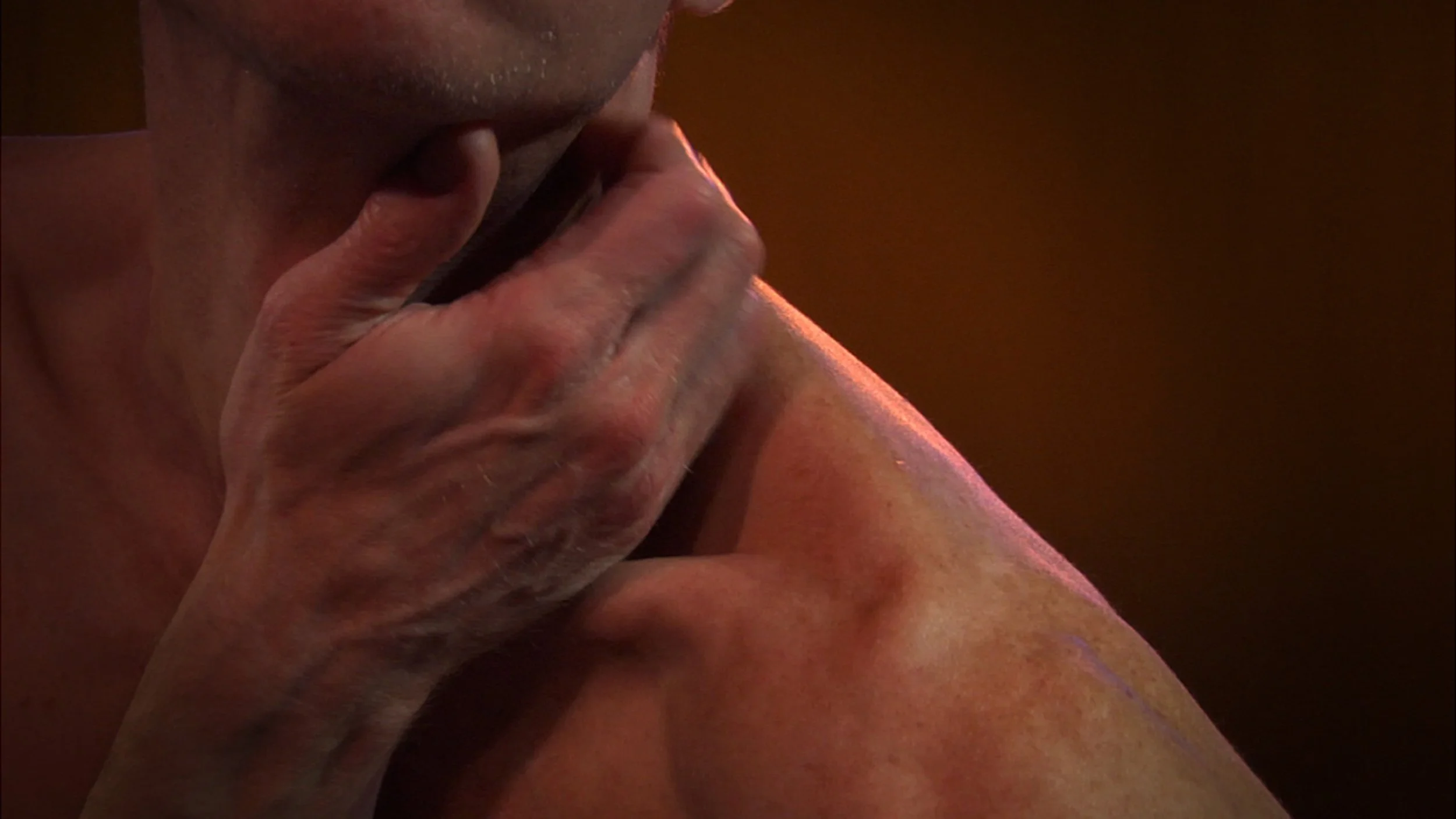
Marlene Millar & Philip Szporer, 40 (2009)

Mouvement Perpétuel: 25 Years of Creating Through Movement
On January 8, 2025 at 7 pm
— Facebook event
Seats are limited and admission is on a first-come, first-served basis. Please arrive a few minutes early.
To mark the twenty-fifth anniversary of Mouvement Perpétuel, Videographe is giving the company carte blanche to put together a program that resonates with their core mission. Marlene Millar and Philip Szporer present Mouvement Perpétuel : 25 Years of Creating Through Movement, a program that brings some of their works into dialogue with those of several of their close collaborators.
"For more than twenty-five years, Mouvement Perpétuel has explored the intersection of dance and cinema. The company approaches film as a choreographic practice: the camera moves with the body, landscapes and spaces shape gesture, and rhythm and breath guide the edit. The films are rooted in a belief that dance, in its myriad forms, offers a profound way to encounter and reflect on the world — its beauty, its complexity, and its fractures. Our conviction is that movement carries memory, resilience, and identity, and that film can deepen and extend these embodied stories.
Collaboration is at the heart of our practice. Each project begins with listening — to artists, to communities, and to the particularities of land and place. This process shapes works that attend closely to the moving body while situating it within broader cultural and ecological contexts.
We are drawn to moments of transition and connection — between generations, between private and public spaces, and between the body and the land it inhabits. Themes of memory, continuity, and transformation thread through our work, not as abstractions but as lived experiences revealed through movement.
Mouvement Perpétuel also invests in the sustainability of the dance and media arts ecosystem, through teaching, mentorship, and dialogue. We seek to foster curiosity and to deepen the conversation between dance and film. The camera becomes a way of seeing — one that brings forward what might otherwise remain unseen.
Ultimately, our films invite reflection. The oeuvre insists on the vitality of the moving body as a site of inquiry and expression. It offers viewers a space to witness the resonance of movement — to connect, to pause, and to consider how dance, like film, is a perpetual force of renewal."
— Marlene Millar and Philip Szporer, curators
Program — 61 min
Curators: Marlene Millar and Philip Szporer
The Hunt, Marlene Millar and Philip Szporer (2005) — 4 min 43 s
The Hunt confronts the viewer face to face with one man’s internal struggle manifesting itself before us, revealed through an intensified fragmented view of dancer, Peter Trosztmer, as choreographed by Sharon Moore.
Butte, Marlene Millar and Philip Szporer (2006) — 5 min 40 s
Poetic and sensual, Butte unfolds over the course of a day, marking the progression of time at four key points - sunrise, mid-day, late afternoon, and sundown. Filmed in Southern Alberta on the plains and ancestral grounds of the Blood Reserve, the camera instinctively accentuates the dancer-choreographer Byron Chief-Moon's deep connection to the land. The film captures images of nature and the connectiveness with the land - undulating waves of wild grass, the slow passage of clouds, pastoral woodland thicket, and streams. The body as landscape is the central image, where the flesh, bone and muscle become synonymous with the land.
The Greater the Weight, Marlene Millar and Philip Szporer (2008) — 5 min 50 s
The Greater the Weight is an exploration of the body as an instrument in a symphony of rupture and flow. A reflection on the moment when one stumbles, sometimes one can recover quickly and get up again… sometimes it’s not that easy.
Singeries, Catherine Lavoie-Marcus and Priscilla Guy (2015) — 7 min 15 s
The bodies of two women stand out from an immaculate white background. These ordinary figures unwittingly transform into automatons, wild animals, freefalling objects, primates.
40, Marlene Millar and Philip Szporer (2009) — 5 min 28 s
A man at a pivotal point in his life: 40-something, still vital and strong yet taking stock, unmasking, and exposing his hopes, passions, vulnerabilities, and regrets. This is the subject of 40, a homage to the late Ken Roy, that follows his journey of self-discovery.
JONTAE, Siam Obregón and Kyana Lyne (2020) — 7 min 48 s
In the austere environment of an empty pool, a performer encounters what it means to face oneself. This hybrid dance documentary is a study on resilience performed by Jontae McCrory.
Am I What I’m Not, Cai Glover and Max Machado (2022) — 3 min 49 s
Perceive me please, even my imperceptibility
And I am a sieve
Grieving when you wash over me
If I could catch flies in the subtle way of leaves
If I could simply rise from the couch and leave
And where then would I be?
So remote and so late that I miss the changing of the leaves
So apathetic in space that I’m ignored by the breeze
centered on a sidewalk walking sideways past railways and cemented things
Concrete misgivings
Heavier than the heavens where I spend my time.
Bhairava, Marlene Millar and Philip Szporer (2018) — 13 min 46 s
Bhairava evokes facets of Shiva, the Lord of Dance, as both the destroyer of evil and the guardian of time. He is fierce and drives terrible deeds, but he is also the Divine Protector and Supreme Guardian; his intention springs from pure compassion. In this work, carried by a strong and deeply evocative musical score and by the singular energy of the ancient site of Hampi, dancer and choreographer Shantala Shivalingappa embodies the presence and distinctive qualities of Bhairava. With her technical mastery and refined expressivity, she alternates between moments of precise symbolic gestures and more abstract body language surging from the powerful and omnipresent persona of Bhairava, creating a vivid incarnation of the deity.
Mouvement Perpétuel is a Montreal-based, award-winning independent production collective specializing in film, video, and new media with a focus on dance. Co-founded and co-directed by Marlene Millar and Philip Szporer in 2001, the group is known for its impressionistic dance-media films, documentaries, and multi-channel installations that explore choreography and offer compelling portraits of contemporary dancers and choreographers across Canada, Québec, and internationally.
Over the past 25 years, the duo have cultivated a distinctive practice within the genre of screendance — also known as dance for camera — merging choreography, cinematography, and sound into unified, expressive works. Their projects often embrace hybrid forms and cross-cultural dialogue, exploring themes of identity, environment, and the poetics of the body in motion. Millar and Szporer continue to expand the possibilities of screendance through both independent and commissioned work, creating films that resonate with audiences around the world.

Dazibao thanks the artists and Vidéographe for their generous collaboration as well as its advisory committee for their support.
Dazibao receives financial support from the Conseil des arts et des lettres du Québec, the Canada Council for the Arts, the Conseil des arts de Montréal, the ministère de la Culture et des Communications and the Ville de Montréal.
Dazibao acknowledges that it is located on the unceded territory of the Kanien'kehá: ka Nation and that Tiohtiá:ke / Montreal is historically known as a gathering place for many First Nations, and today, is home to a diverse population of Indigenous as well as other peoples. Guided by ethics of respect, listening, and awareness, Dazibao commits to a continued reflection regarding the deep-rooted and systemic challenges tied to accessibility and inclusivity in the arts and beyond, and endeavors to apply such reflections to all aspects of its activities and governance.