
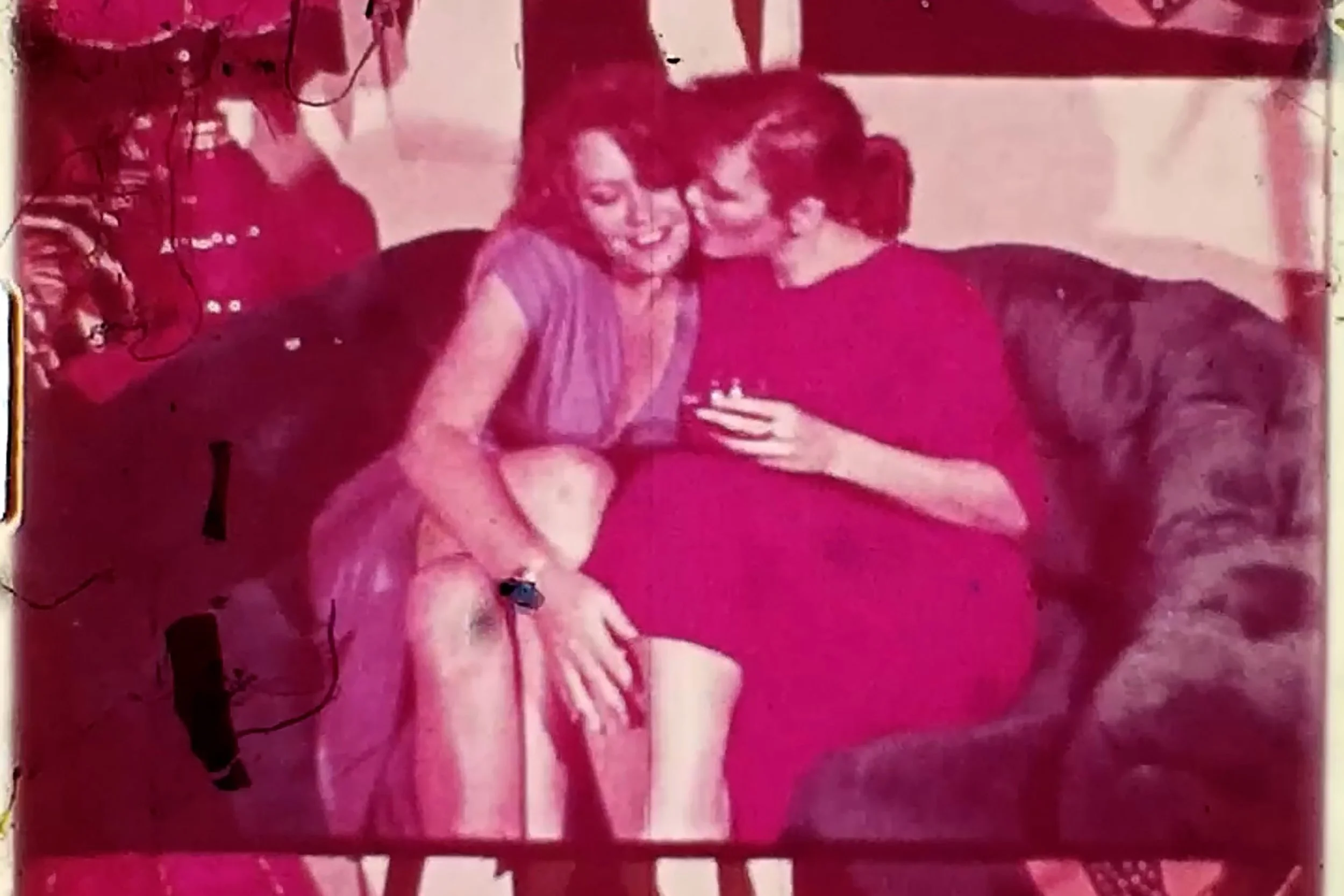
© Chantal Partamian, آثار Traces (2023)

Carte blanche to Frédéric Moffet: Love Is a Stranger in an Open Car – An erotic dérive through the collection
On May 28, 2026 at 7 pm
Seats are limited and admission is on a first-come, first-served basis. Please arrive a few minutes early.
The dv_vd series is an initiative by Vidéographe and Dazibao. The aim of this collaboration is to create a dialogue between the centre’s collection and the current video art scene. For this edition of dv_vd, carte blanche was given to Frédéric Moffet to create an original program as part of the series. The curator presents a selection of works that explores desire, memory, identity, and the politics of representation.
The lights go down. Bodies settle into their seats. You look around the screening room. Someone sneaks in late, sits in the front row. The audience fades into silence. From the back, a beam of light cuts through the dark.
The looping sound of a moving train hypnotizes you. A spell is cast. You rehearse three scenarios in your head: deception, refusal, surrender. He looks at you. You slip into an empty compartment. You undress. In the morning, disoriented, you sneak out, leaving the bed unmade.
Now you are at dinner with friends. Your partner sits by you. As you tear into a chicken thigh, a caged bird thrashes, sensing its own demise. Under the table, bodies brush discreetly. The evening is pleasant enough but you want to escape. Your partner climbs onto the back of your motorcycle. You race into the night, leaving him cold as ice. You shower together. The steam revives him. Your bodies blur, merge, morph into one.
Morning arrives. You are back on your motorcycle, circling the city, hunting for trouble. You enter an apartment crowded with naked men posing for the electric eye of a camera. You remove your helmet, your clothes, aching for release. It comes—again and again. Yet something is off. Pleasure doesn’t always please. A line of coke and a cigarette would have been just fine.
Back on the street. A war-torn city, elsewhere. You keep looking for trouble. Here, men are fully clothed, masked, and armed. Danger is tangible. You discover an old reel of film underneath the rubbles. From the scratches and dust on the celluloid, two women in party dresses emerge. Softly, they succumb to their longing. A passionate trespass arises and disappears just as quickly. Desire slips back into the archive, concealed for safety.
On the road again. A desolate highway in grainy black and white. Four friends in a car, chasing ecstasy. In a cheap motel room by the highway, you succumb to his attraction. He pulls off his shirt. Your bodies come together. The others join in. Soon doubt seeps in. Chemicals toy with your head. You feel abandoned, undesirable. No… this is not your scene. You leave. Later, during the ride back home, you’ll try to reclaim your desire. Always crashing in the same car.
Now you float above landscapes and bodies, the electric eye of a goddess. Again, three scenarios: a laughable hookup, a missed opportunity, a tale of love. Yes, love. Tender, unguarded, enduring. You see yourself on your motorcycle orbiting a polyamorous bacchanal. You feel weightless. Free.
The lights in the room turn back up. Your eyes adjust. The latecomer in the front row stands, slips toward the back door. You tell your friends you need the restroom. You exit the screening room, never to return.
— Frédéric Moffet
Program — 60 min
Monique Moumblow, Sleeping Car (2000) — 5 min 30 s
Philippe Hamelin, Lèvres Bleues (2020) — 8 min 18 s
Marc Paradis, Deliver Us from Evil (1987) — 9 min 45 s
Chantal Partamian, آثار Traces (2023) — 8 min 45 s
Karl Lemieux, Passage (2007) — 15 min
Alexa-Jeanne Dubé, Scopique (2017) — 12 min 6 s
-
— 5 min 30 s
"I get on the train in a small town..." A woman's voice is heard. A narrative resembling an old foreign film – with subtitles, black and white images, and a woman speaking in Swedish – is told on a train. Will she find her lover? The story unfolds in three different ways. As the film progresses, the voice and subtitles begin to drift apart. The train continues on its path.
-
— 8 min 18 s
In making Lèvres bleues, Philippe Hamelin was interested in using computer-generated imagery as a reconstructive tool – in this case using it to reconstruct a lover's memory. The story comes from a collection of accounts told by strangers who the artist met on dating sites in 2008. The memory takes form through matter, objects, movement and the senses. In the animation, human mechanisms and machinery are placed in parallel, while the apparatus of narrative mechanics is explored. There is a crossover between the human being's interior movement (its feelings) and its movement in space. The dramatic expectations too often linked to representations of love between two men are derailed.
-
— 9 min 45 s
Close-ups of lovers caressing and images of nearly motionless nude males are presented as a collage. A young man feverishly comments upon le mal d’amour by confronting desire and disappointment, including moments of his everyday life and moments which occur in a dreamlike state. This results in an opposition between the primitive simplicity of sexuality and the complexity of love to which we traditionally associate it. This work focuses upon the omnipresence of sexuality and its inevitable changes and ramifications in long-term relationships.
-
— 8 min 45 s
Beirut 1980: Amid the rubble of a torn building, a reel of film. An unlikely unravelling of queer bodies taking shape and form, while the war-torn city around and its spectacle of toxic masculinity glitches and disintegrates
-
— 15 min
Exquisitely filmed in black-and-white, this experimental narrative follows four friends on a road trip as they discover the complicated arena of unseen desire that arises when ecstasy and sexuality mix.
-
— 12 min 6 s
Scopique is a triptych of erotic art videos uniquely filmed with a drone. The project unfolds through a succession of long takes where we become deeply submerged into the intimacy of two people. Complemented with music and real life testimonies exploring sexuality, Scopique is a unique, voyeuristic and aesthetically beautiful experience.
Frédéric Moffet is a media artist, educator, video editor, and cultural worker. He was born in Montreal but now lives in Chicago where he works as a Professor at the School of the Art Institute of Chicago. His films explore the slippery territory between history, lived experience and fantasy.

Program
Dazibao thanks the artists, Frédéric Moffet and Vidéographe for their generous collaboration as well as its advisory committee for their support.
Dazibao receives financial support from the Conseil des arts et des lettres du Québec, the Canada Council for the Arts, the Conseil des arts de Montréal, the ministère de la Culture et des Communications and the Ville de Montréal.
Dazibao acknowledges that it is located on the unceded territory of the Kanien'kehá: ka Nation and that Tiohtiá:ke / Montreal is historically known as a gathering place for many First Nations, and today, is home to a diverse population of Indigenous as well as other peoples. Guided by ethics of respect, listening, and awareness, Dazibao commits to a continued reflection regarding the deep-rooted and systemic challenges tied to accessibility and inclusivity in the arts and beyond, and endeavors to apply such reflections to all aspects of its activities and governance.