
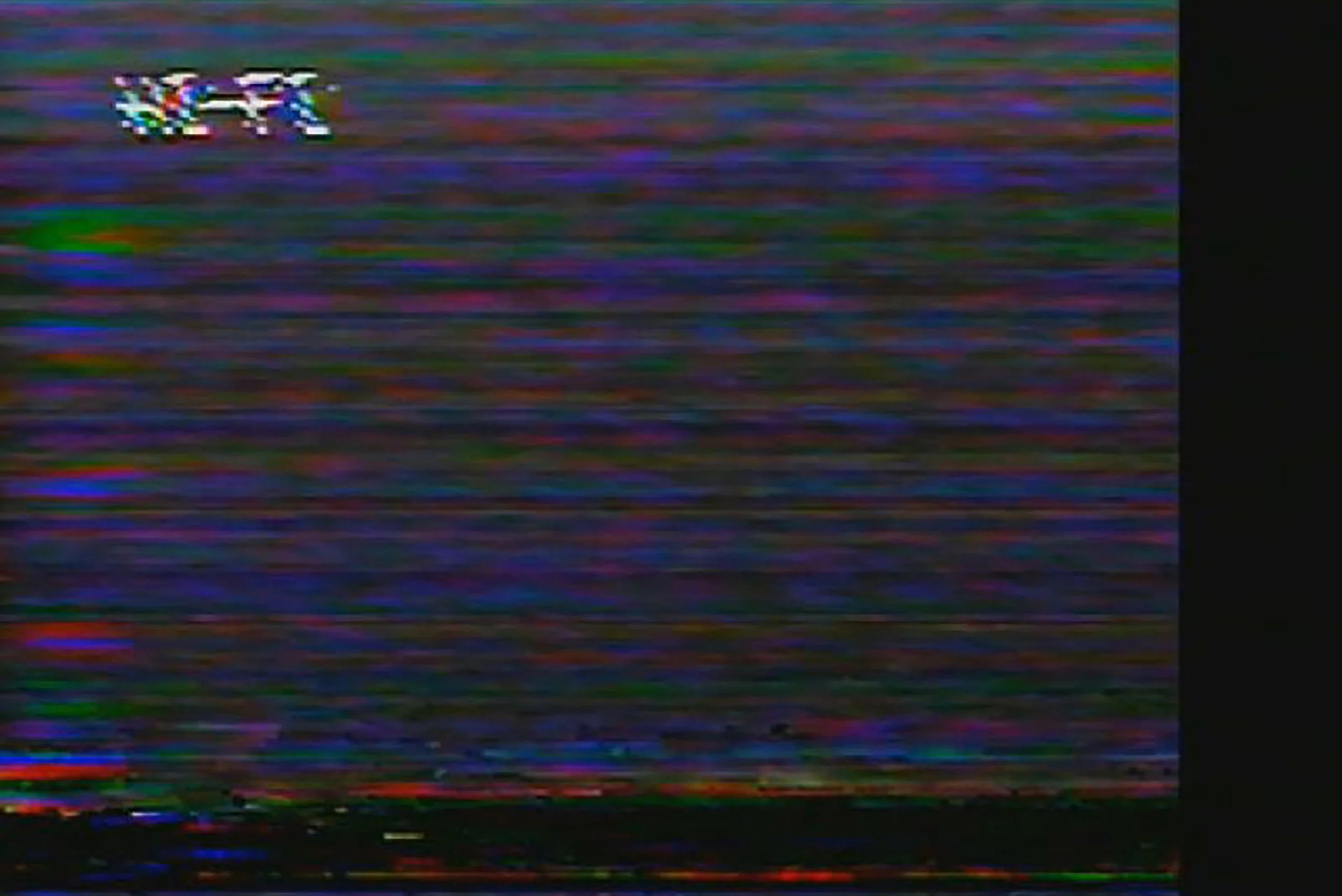
© Rob Feulner Quiñones, Puerto Rico Tautology (2016)

Carte blanche to Rob Feulner Quiñones — NOT VERY PRETTY, BUT QUITE TASTY
On December 10, 2026 at 7 pm
Seats are limited and admission is on a first-come, first-served basis. Please arrive early.
The dv_vd series is an initiative by Vidéographe and Dazibao. The aim of this collaboration is to create a dialogue between the centre’s collection and the current video art scene.
Warning
The quality of this video varies due to older technologies and image degradation.
A trigger warning for aestheticists. The bruised fruit of video art. Disregarded, discounted, unsold, thrown away. A metadata field in the Vithèque catalogue that practically yells at you to keep walking, unless of course you’re a particular type of person with particular sensibilities. The bug becomes a feature, a promise of texture and corruption. I go out of my way to unscrew the tops from VCRs, risk a thin layer of skin by jamming my fingers between a moving playhead and those vertical pins that hold up the magnetic tape whose name I never bothered to learn, all to create the same texture and corruption that’s built into the pieces in the Vithèque collection. Are these cast-aside videos from the 70s through the 90s decaying or evolving?
The distortion is apparent in films like Réaction 26 and Trisha and Carmen. VHS tracking errors pop in uninvited, the pitch warbles like a gastronomical rejection. Others, particularly K. Kay’s poetic letter to home in the form of a videotape, are a bit more subtle. If she were to see Vithèque’s copy of Little Fairy Hill, Big Fairy Hill back in 1973, would she be upset by the slight video artifacts sprinkling across the screen? Or would she say, “Wow, this looks exactly as I remember”? If these slight bits of corruption were inherent in the early days of video technology, the days when artists marvelled that a film could be shot and presented in the same hour, should we consider them corruption? Flaws are natural; perhaps imposing perfection on video is a flaw in itself.
Nitro implose was physically lost at Vidéographe, perhaps it decayed into nothingness, recently replaced with a new master. It shares all the flaws inherent in any VHS master, but in an age where VHS texture is not just accepted but celebrated, there is no need to inject a warning to the Vithèque website. Corruption flows with the culture. Other films, like Ode 1:23:06, seemed flat-out misunderstood when uploaded. Early video glitch, the corruption is the massage, perhaps so ahead of its time that the developer maintaining the Vithèque database assumed something awful happened to the master tape. This introduces the idea of reclaiming distortion and decay, inviting it into your art as a part of the tapestry. I programmed one of my own films, Puerto Rico Tautology (14 dubs high), as an example of pushing the medium into decay, creating the point of no return where no art exists. Artists like Charlotte Clermont and Frédéric Moffet brilliantly explore the limits of their preferred mediums, where the error is a reflection of the self and the moving image.
In my ideal Vithèque catalogue, this warning would appear on all the videos. Each one would naturally decay over time. We would exist in a state of pre-mourning for ProRes files with data blocks that age and fall out like hair in the shower. Fifty years down the line, we remember the dead by opening their folders and celebrating their devolution.
— Rob Feulner Quiñones
Program — 55 min
Charles Binamé, Réaction 26 (1971) — 4 min 35 s
Irène Mayer, Nitro implose (1990) — 7 min 16 s
Burt Barr, Trisha and Carmen (1988) — 13 min 4 s
K. Kay, Little Fairy Hill, Big Fairy Hill (1973) — 10 min 10 s
Yvel Champagne and René Roberge, Ode 1:23:06 (1991) — 1 min 48 s
Rob Feulner Quiñones, Puerto Rico Tautology (2016) — 6 min 58 s
Charlotte Clermont, Parking Lot Attendant (2016) — 3 min 57 s
Frédéric Moffet, Postface (2011) — 7 min 12 s
Rob Feulner Quiñones (b. 1987) is a video artist hailing from Montréal. Armed with a stack of VCRs, circuit-bent equipment, and a disregard for electrical shocks, Rob Feulner Quiñones dives wrist-deep into open machinery to manipulate tape heads and moving parts, creating a landscape of video tracking errors and glitches used to confront modern political malaise. His work has appeared in the Indianapolis Museum of Art, has been broadcasted on Adult Swim, featured in Matthew Rankin's Ladies and Gentlemen, Brian Mulroney, and provided visuals for a performance of Anne Carson's Antigonick, in collaboration with the Nobel Prize-winning author. Established in 2014, Feulner's video art label Bleu Nuit Video curates underrepresented like-minded artists through DVD and VHS home releases.

Dazibao thanks the artists, Rob Feulner Quiñones and Vidéographe for their generous collaboration as well as its advisory committee for their support.
Dazibao receives financial support from the Conseil des arts et des lettres du Québec, the Canada Council for the Arts, the Conseil des arts de Montréal, the ministère de la Culture et des Communications and the Ville de Montréal.
Dazibao acknowledges that it is located on the unceded territory of the Kanien'kehá: ka Nation and that Tiohtiá:ke / Montreal is historically known as a gathering place for many First Nations, and today, is home to a diverse population of Indigenous as well as other peoples. Guided by ethics of respect, listening, and awareness, Dazibao commits to a continued reflection regarding the deep-rooted and systemic challenges tied to accessibility and inclusivity in the arts and beyond, and endeavors to apply such reflections to all aspects of its activities and governance.