
Maude Pilon — "Jeunes phrases sur les flammes" et la farine
Maude Pilon — "Jeunes phrases sur les flammes" et la farine
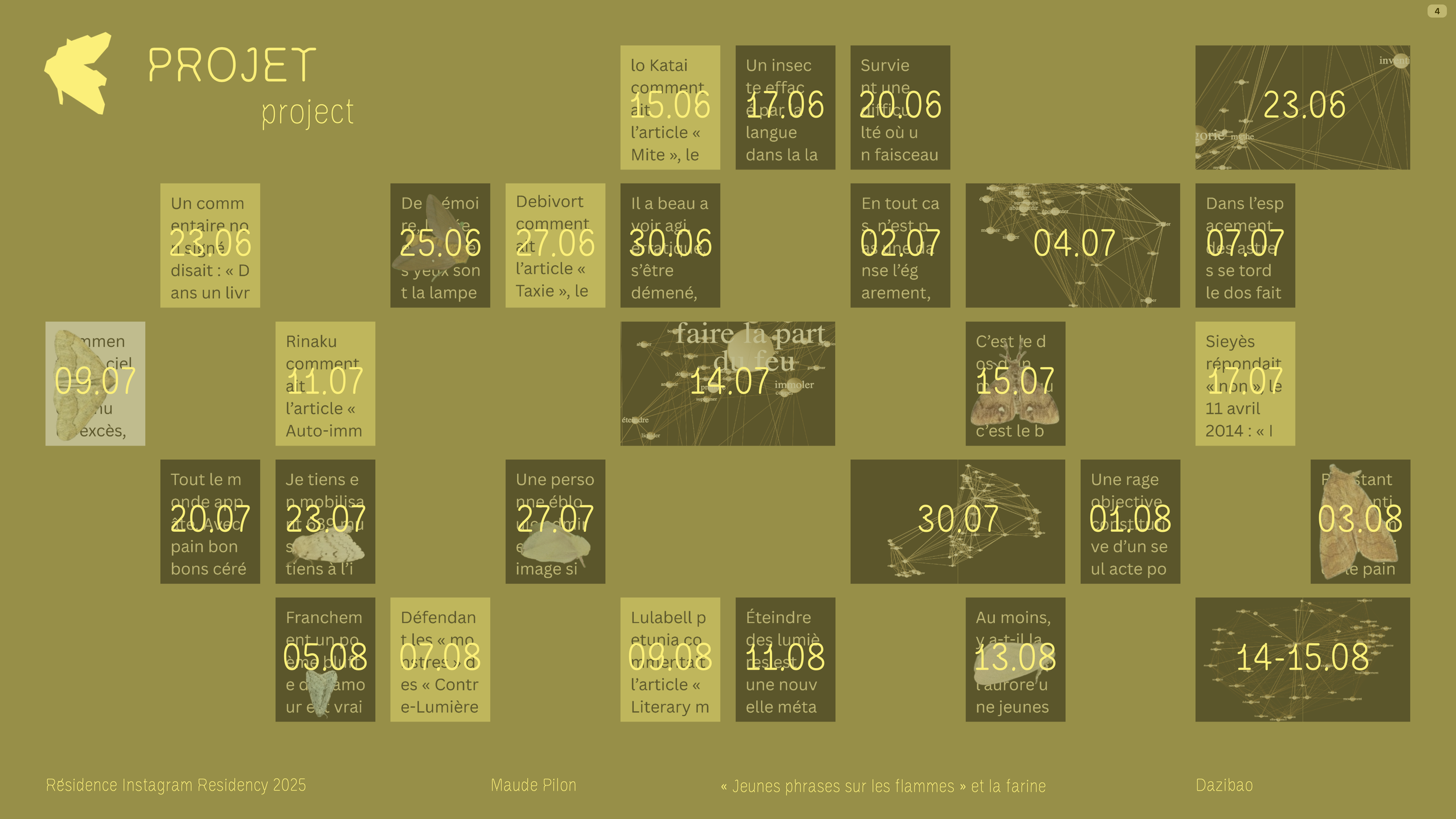
This digital publication documents Dazibao's 2025 Instagram Residency. From June 15 to August 15, writer Maude Pilon took over our account to develop her project “Jeunes phrases sur les flammes” et la farine.
For a better reading experience, we recommend you download the free Thorium Reader application (available for Windows and Mac environments).
Artist: Maude Pilon
Interview: Sayaka Araniva-Yanez
Instagram residency and publication under the direction of France Choinière
Assisted by: Émylie Bernard
Design: Violette Moukhtar
Editing: Émylie Bernard, France Choinière, Joanie Demers, Emma-Kate Guimond, Jeanne Robichaud
Translation: Käthe Roth
2025
In English and in French
ISBN: 9782922135701 (EPUB)
Maude Pilon approached her Instagram Residency as an expansion of her current research on the phenomenon of attraction and phototropism. “Jeunes phrases sur les flammes”¹ et la farine reflects on literary figurations of the moth – those who seek the light, and those of the pantry variety, who seek obscurity – piecing together the writer’s entomological observations and textual findings.
The writing grounds lay beneath nightime’s mock moon, and a moth-adoring literature is foraged.
Under the lamppost, the betrothed triphene is devoured by the illusion of safety - I look up the etymology of immolation and find immolare: sprinkling flour on the sacrificial animal - The chrysope, disoriented for days, no longer leaves the white wall ("in spite of the width of the sky”²) – It's mentioned that flour was also sprinkled in the sacrificial fire – The bark fly holds to the trunk, directly in the light beam of a narrow ray that manages to penetrate the canopy – I return to the path of my first entry, immolation, now not so much in the sense of sacrifice, but closer to the disaster of attraction – The aphid wants the bright flower – Before being devoured, the betrothed triphene quivers, frenetic - It's not a dance, but a panic – No longer literature, but derangement – The moth lays its eggs in the flour, but the moth's morning is its end – Each new day, at breakfast, there, where one has panicked, empathy is always already lacking.
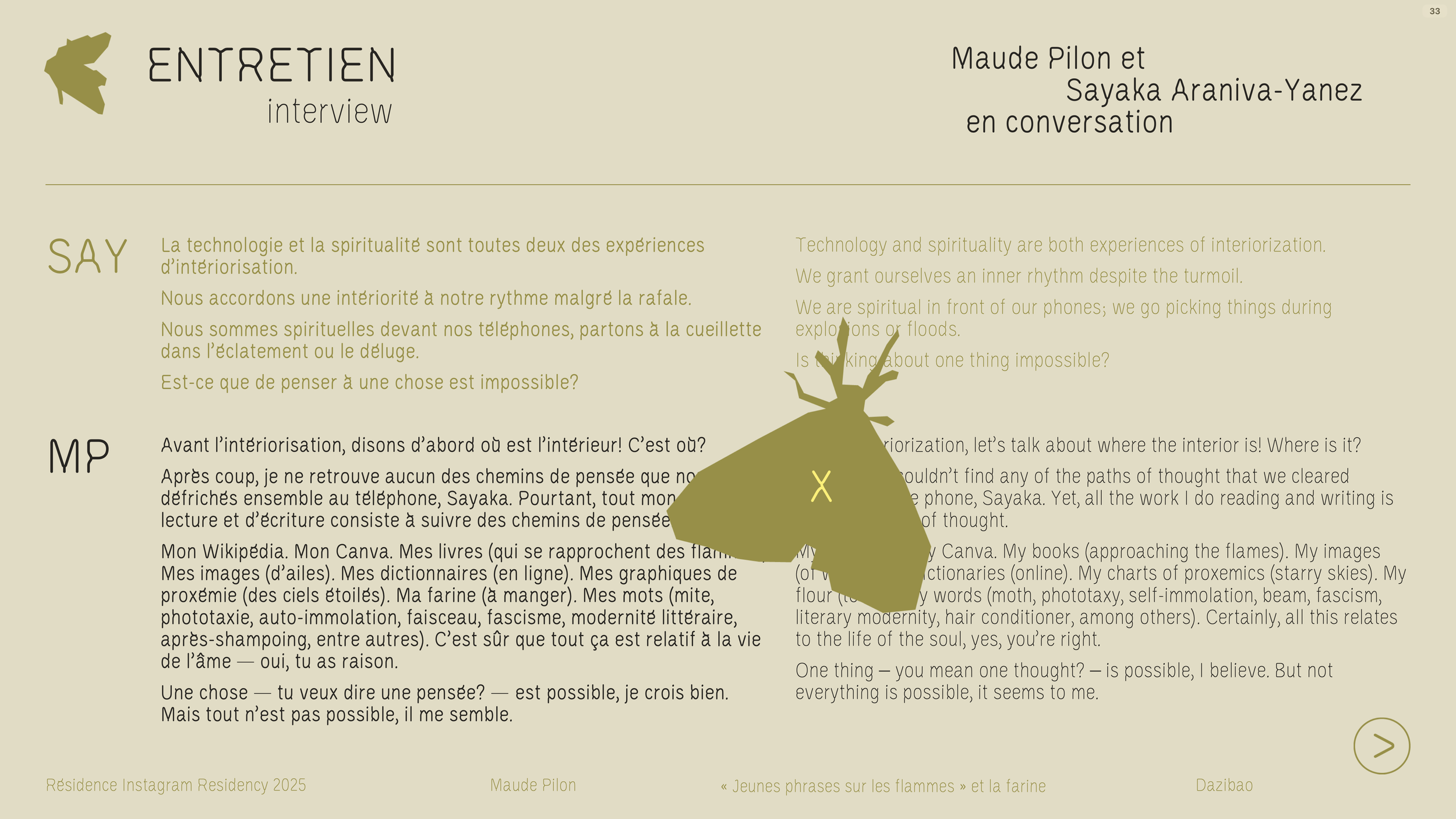
An interview with Sayaka Araniva-Yanez elaborates on those notions, raised by Pilon, while capturing a shared perceptiveness. Their questions draw us into a fluttering dialogue between light and darkness.
1. Gaston Bachelard, La flamme d’une chandelle (1961).
2. Virginia Woolf, The Death of the Moth and Other Essays (1942).
Maude Pilon is a writer. She works in a diverse range of collaborative, academic, union, medical and artistic contexts. Her writings take the form of arranged readings, recordings, printed works and research-creation contributions to publications and journals. Her current work focuses on voluntary decay in modern mystical thought, the diaries of writers and the writings of artists. Her most recent work is À midi, une joie, published by Herbes rouges (2024).
Instagram residency

Maude Pilon
From June 15 to August 15, 2025